

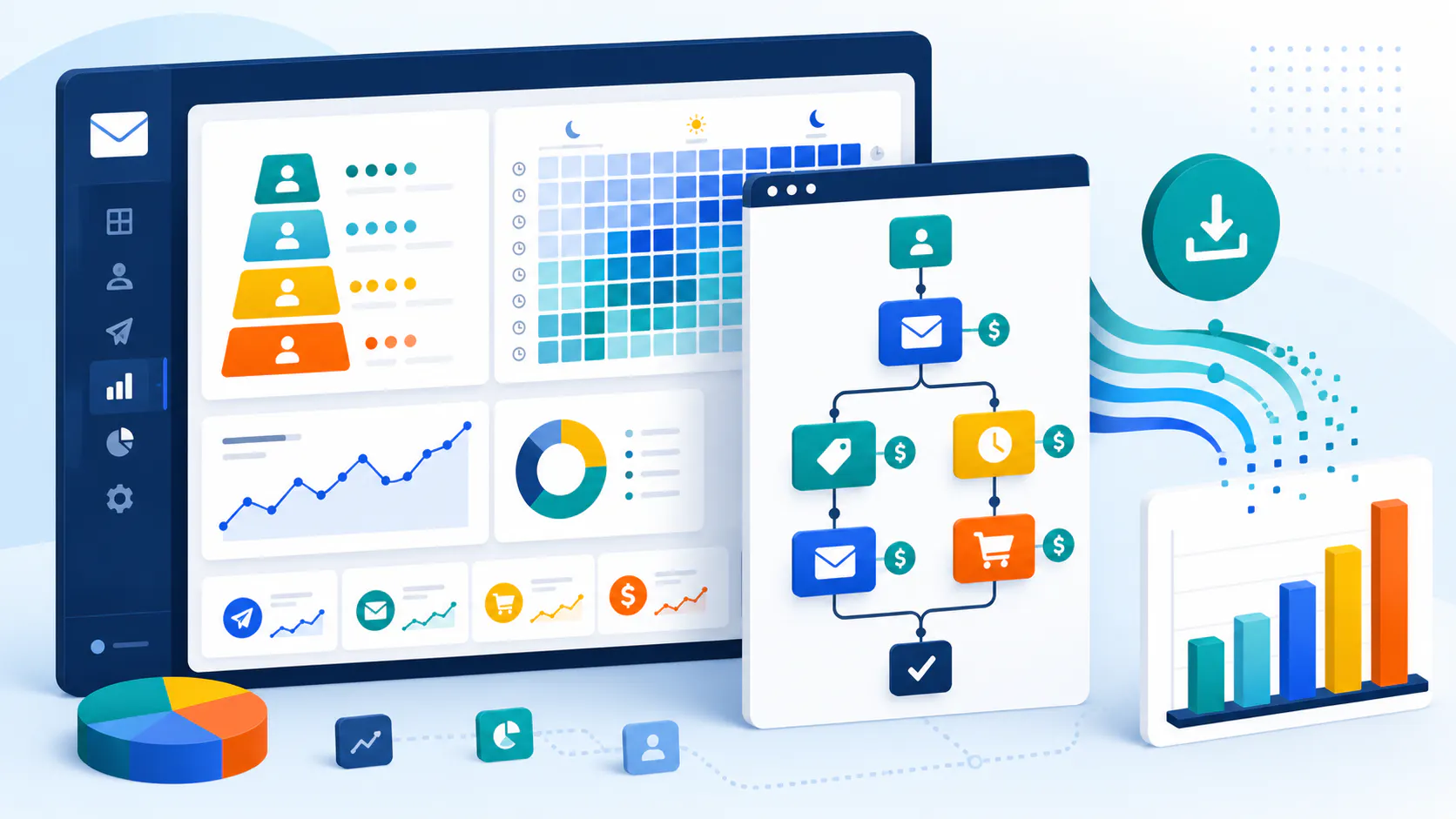
We shipped Octeth v5.9.1 today. 123 merged pull requests, 261 commits, approximately 8 weeks of development — and the most reporting-focused release we've ever done.
The through-line this cycle was visibility. Not just more charts in the interface, but a deeper, exportable, programmable layer of analytics across the entire platform: lists, journeys, campaigns, and the Email Gateway. If you manage email for clients and need to tell a data story — or if you want to build your own dashboards on top of Octeth without touching the UI — this release is built for you.
Let me walk through the major areas.
List Analytics Suite
This is the headline feature of v5.9.1. We've shipped a full family of list reporting endpoints that turn every subscriber list into a properly measurable asset.
Previously, a list had a few numbers attached to it: subscribers added, unsubscribes, maybe some basic open and click rates. That's not enough to actually understand how a list is performing or where trouble might be developing. The new List Analytics suite changes that substantially.
What's now available for every list:
- Activity over time — a time-series view of list activity so you can see momentum, not just a snapshot at a single point
- Subscriber status breakdown — the actual composition of a list by subscriber state, which matters more than the headline number
- Bounce trend — track bounce rates over time so deliverability problems surface early, before they become sender reputation problems
- Engagement tiers — group your audience into hot, warm, and cold segments based on actual behavior
- Send-time heatmap — a grid showing when your subscribers actually open, so you can schedule sends for the windows that work
- Tenure distribution — how long different cohorts of subscribers have been on the list, which is a useful proxy for list quality
- Mailbox provider breakdown — where your audience lives, which affects deliverability strategy significantly
- Click-through retention matrix — engagement decay over time, so you can see whether a list's responsiveness is holding up
For anyone running campaigns for clients, "the list grew by 400 subscribers this month" is a weak report. This suite gives you the material to tell a real story: where the list is healthy, where it's aging, when to send, and which segments need attention before deliverability slips.
Email Gateway Reporting and Management
The Email Gateway got a significant reporting and management layer in this release.
On the reporting side: account-level sending statistics in one view, and exportable event logs so you can take your delivery data into your own systems. On the management side: recipient-domain listings with counts (so you can see exactly where your mail is going), signing-key regeneration for clean credential rotation, and safer handling of outbound webhook configurations.
For agencies running sending infrastructure across multiple client accounts, having both the overview dashboard and the raw export covers two very different workflows — the quick health check and the deep reconciliation. Both are now in place.
Journey Reporting and Bulk Operations
Journey Builder gains a reporting layer that connects automation activity to actual outcomes.
The core addition is stats broken down by mailbox provider and by individual journey action, so you can see not just overall performance but where in a workflow subscribers engage or fall off. Per-action revenue attribution is also in this release — which means you can tie specific journey steps to revenue and build the kind of before/after analysis that makes automation investment legible to clients.
Beyond reporting, there's a benchmarking feature that compares a journey's performance against your account baseline, activity counters across a journey's lifecycle, async export for large journeys, and bulk operations across multiple journeys at once.
"The automation is running" and "the automation is making money" are two different things. This release gives you the data to know which one is actually true.
Campaign Reporting and Export API
Campaign reporting gets faster and significantly more capable.
The additions here include a proper campaign export endpoint, subject-line search across campaigns, aggregate engagement sums (so you can pull totals across many campaigns in a single call), and faster count queries for dashboards that need to load quickly on large accounts.
Segment counts are now recomputed in the background rather than inline, which keeps reporting screens fast even on accounts with complex segmentation. If you've ever watched a segment count page spin, that should be noticeably better.
Suppression, Subscriber Management, and Source Attribution
A few additions here worth calling out:
Global and per-list suppression APIs, plus an SMS suppression API — so suppression management is now fully programmable across all channels.
Subscription source attribution — you can now see which sources are actually driving list growth, with a breakdown by source type. This answers a question clients ask regularly and that previously required manual analysis.
Select-all matching subscribers — bulk actions now apply to the entire filtered set in one operation, not just the current page. This sounds minor but makes a meaningful difference when you're managing large lists.
Richer subscriber detail — including journey-progress fields in Subscriber.Get, which is useful for debugging automation behavior on individual subscribers.
Two New Integrations
We've added native integrations for ClickBank (instant notification-driven workflows) and PromptEMR (a healthcare practice management platform). Both are available immediately.
We also retired a few legacy CRM and form integrations that have been largely unused for some time. If your account relied on any of them, you'll want to review that before upgrading.
Reliability and Quality
37 bug fixes in this release. A few areas worth highlighting:
Journey stability — more consistent canvas saves, cleaner handling of edge cases around lists and custom fields, and better behavior when a decision step hits a timeout or an unexpected condition.
Subscriber and list integrity — graceful handling of edge cases during unsubscribes, more accurate suppression flags, and corrected stat attribution across lists and snapshots.
Sending correctness — cleaner handling of sender display names with special characters, preheader validation, and sender-domain consistency across the platform.
Upgrade and migration robustness — schema changes in this release use non-blocking DDL operations, which means upgrades don't require taking the platform down during migrations. For accounts with large tables, this is a meaningful improvement.
v5.9.1 is a substantial release. The reporting and API work is broad — it touches lists, journeys, campaigns, and the Email Gateway — and it's the kind of infrastructure investment that compounds over time. Every new endpoint is a building block for dashboards, integrations, and client reporting workflows that weren't possible before.
We'll be building on this foundation in the next cycle. The data layer is now much more complete; the next work is making it easier to surface that data in the places you actually need it.
If you're an existing Octeth client, log in to the Octeth Client Area to download v5.9.1.
If you're evaluating Octeth or want to see what it can do for your organization, fill in our contact form and we'll be in touch.
Octeth is a self-hosted email marketing platform built for businesses and agencies that need full control over their email infrastructure. Learn more at octeth.com.